




































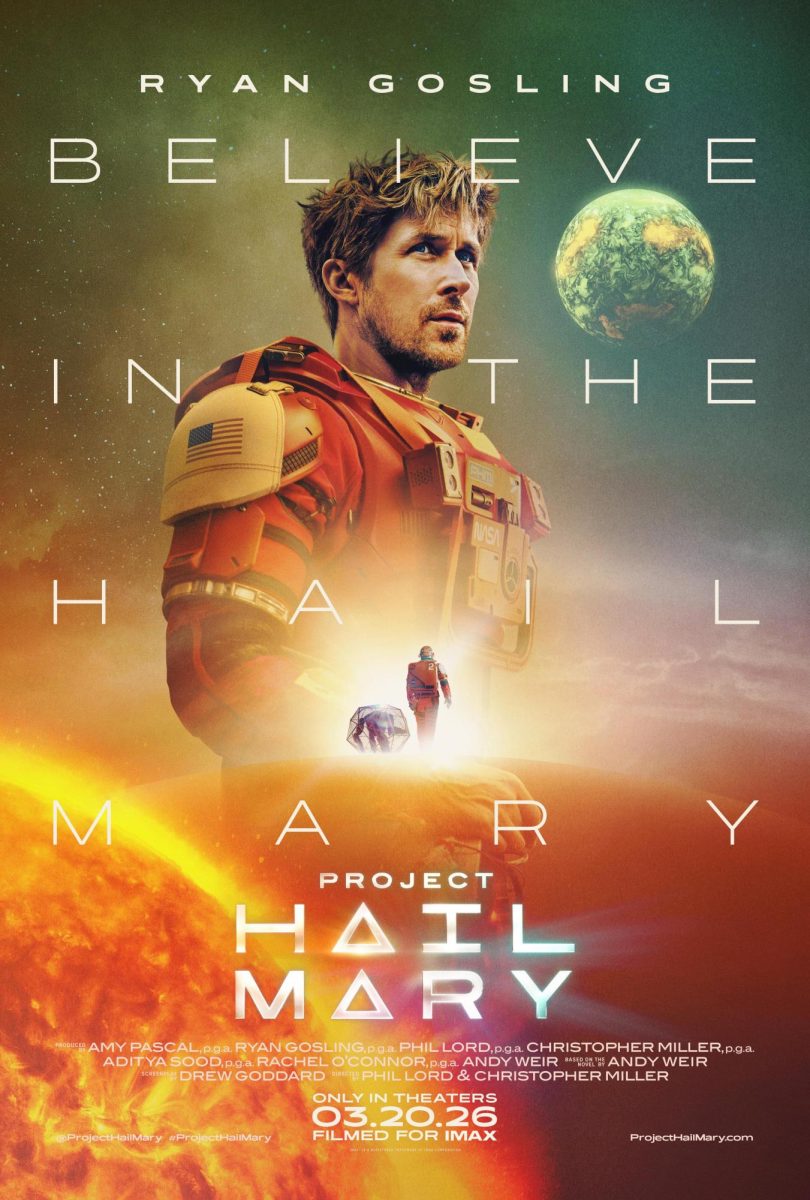
“Project Hail Mary,” a 2026 science fiction film directed by the duo Phil Lord and Christopher Miller, is based on Andy Weir’s 2021 novel of the same name.
The movie starts with scientist Ryland Grace, portrayed by Ryan Gosling, awakening inside a spacecraft with no recollection of his past, traveling to an unknown destination. As the movie continues, Grace periodically regains his memories, remembering his mission to save the Earth from a mysterious extraterrestrial organism rapidly decreasing the sun’s energy. Along his journey, Grace befriends an alien who’s suffering from the same situation, and together, they work to save their sun and return home.
Ryan Gosling’s portrayal of Ryland Grace is nearly identical to the novel version. Gosling exudes his natural charm while embodying Grace’s introverted, witty qualities. His performance as a scientist comes off as believable due to his confidence in the delivery of his lines and body language.
One aspect that separates this film from other science fiction media is the essential role that science plays. There’s no conclusion Grace reaches without heavily theorizing and testing his ideas. Lord and Miller also allow the audience to see Grace’s intelligence by the different revelations he makes throughout the story, and there is no point at which I felt hand-held through long-winded explanations. Each milestone Grace makes doesn’t come through some action sequence, but rather a discovery and a deeper understanding of the space around him.
But the heart of the film comes in the deep relationship formed between Grace and his alien companion. When stripping away the high stakes and context surrounding it, you get a story about overcoming trauma, and the loneliness that comes with it, through friendship. The special bonds between Grace and his friend and the self-sacrifices they endure for each other are the most memorable parts of the film. Lord and Miller carefully show us each step taken and the trust gained between the two. You can see firsthand the lengths they go through to ensure each other’s survival.
Even though the film handles depressing themes such as death, loneliness, bravery and the meaning of heroism, the central relationship leaves a lingering sense of optimism in the narrative. This is also shown by the original soundtrack. Score composer Daniel Pemberton perfectly embodies the whimsical aspect of the film. Tracks like ¨Amaze Amaze Amaze (Life on Erid)¨ add onto scenes instead of fading into the background.
I believe “Project Hail Mary” stands with the other great sci-fi films, like “Blade Runner” and “Interstellar,” while making a distinct name for itself. I would recommend this film to anyone interested in science fiction movies or who has a soft spot for a heart-warming film about friendship.

Pye • Apr 27, 2026 at 2:51 PM
This is insanely good, Darnell