


























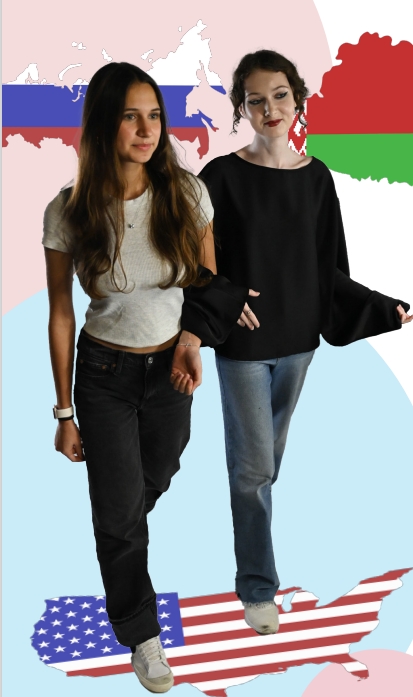
For most people it is unimaginable, but for junior Vanessa Iusico and senior Vera Karol, it is reality. Both of them moved to the United States, Iusico two years ago from Russia, and Karol three years ago from Belarus. And whilst Iusico and Karol moved to the U.S. from two different countries, they shared similar experiences in adjusting to their new environment.
“It’s [a] new experience, you don’t know [the] language, it’s [a] new society, and [a] new mentality for you. So it was difficult, but this experience was very useful in life,” Karol said. Both of them moved with little to no knowledge and understanding of the English language, and struggle with it to this day.
“There [are] so [many] [situations] when … people [ask] me one thing and I answer … [something] different … because in my head, it’s… [a] different question. And I answer it, and they’re like ‘what are you talking about?’ And [then] they’re like ‘okay, I’m gonna go’ … I’m fine with that. [I’m] just used to it,” Iusico said.
The school offers programs and help for students who transfer from different countries. Spanish teacher Kailey Keels, head of the world languages department at Wando High School, helps teachers
to support students through this transition.
“My job is to support teachers in supporting students,” Keels said. “That means I push into a few classes… a couple days a week … I take whatever they’re learning, and I try to use that information to build their academic English.”
Not just Keels, but also the students’ teachers play a role in helping their students do well at Wando. Their support and encouragement in learning a new language can be very valuable.
“Our teachers here are really, really understanding and empathetic … I think really the communication with me is a huge piece … providing me with the material to grow their English and then being flexible with the students and accommodating them in ways that help them learn the standard, but also do it in a way that’s not overwhelming,” Keels said.
Iusico, who had originally gone to a different school in the U.S., has had unique experiences at both schools.
“In my first school, there [were] a lot of people who [did not] speak English, [so] the [teachers] … [didn’t] … pay attention [to the fact that I] speak [a] different language,” Iusico said. “At this school, my English is better and I don’t need … any help with it … all of them asked me … if I need any help … [or if] they need to speak … slower.”
Learning a new language does not stop in the classroom.
“When you start finding friends and talking [to] people, it’s easier to speak English and … learn the new language,” Iusico said. Iusico is adjusting to the new language, but she is still reminded of the fact that it is not her native language on a daily basis.
“[Sometimes] when [I’m] talking to people, and they hear [my] accent … [they say], ‘Oh my gosh, you have such a cute accent. Where are you from?’ This is so sad because … I’m trying, I’m trying, I’m trying. And then this question and I’m like, no, no,” Iusico said. “I’m … trying completely to switch to English. Of course… my native language is important, but I would like [to try] to speak [without an] accent.”
The two are still adjusting to their new lives and getting used to such a different culture, but they still are excited for what is to come.
“I like [the] people’s mentality because [they’re] very open to talk, to connect, [they’re] very kind. It’s [a] pleasure,” Karol said.
Iusico is already looking forward to spending her future in the U.S. She has dreams and plans in this country that she looks forward to fulfilling.
“I love life here, and I’m thinking about college and all that. I don’t see [myself] going back to Russia,” Iusico said.
For other transfer students who might go down the same paths, they share advice.
“Just give [yourself] the time to [get used to] the new area, [and] to the new [people]. Just be open, be kind and want to connect with people,” Karol said.
Iusico does not want to be stuck in the past and instead looks into the future. To her, that is the biggest step.
“[I] just need to move on from it,” Iusico said. “Everything in Russia, it’s in the past. It should be in there. Right now I’m moved and I have to … find a way how I can live here and make my life better here.”